Early Church Mosaic Floor from Samaria
The language in Samaria of the early centuries seems to have been mixed even more than it was in most of Israel. Samaria lies just north of Jerusalem. Before Greek was universally imposed in Israel in the first century, the Samaritans used a mutated form of the Paleo Hebrew script. It seems to be a language that was their own. The ensuing political pressure of the Roman Government imposed an even greater mixture of languages in Samaria. Icons became a universal language in the first century in Samaria.
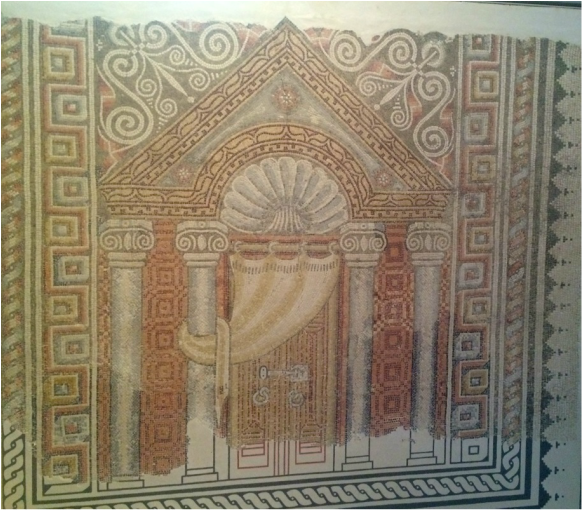
The early church mosaic floors that have been found in Samaria graphically portray clear messages of their beliefs. One that has been found in Samaria contains the common icons that were well known at the time. It portrays the icons of the Temple in Jerusalem. It has four pillars in the front that represent the pillars in front of Temple known as Yachin and Boaz. The four pillars indicate that this is a representation of the second Temple, which stood in the time of Christ.
The top of the structure has the typical triangle that represents the Holy of Holies. The triangle has three six leaf rosettes in it, which are the icons of the house of David. In the middle of the triangle is the starburst, which represents the Shekinah Glory of God.
There is a curtain in front of the Temple doors. Some think that this curtain indicates that there was a curtain in front of the doors but the details of the Temple in the Biblical text do not mention a curtain in front of the doors. Remember that icons are symbols with specific meanings; they are not pictures of the actual structure. The Temple did not have a pitched roof so the triangle above it does not picture the roof but rather represents the Holy of Holies. There was not a starburst above the doors but rather the starburst represents the Shekinah Glory of God. The curtain in front does not picture an actual curtain that covered the doors but rather it represents the veil to the Holy of Holies.
The veil in the Temple was torn in two from top to bottom when Christ died on the cross. God tore the veil in two indicating the change in practice for believers in the God of Abraham, Isaac and Jacob. The change God made was the change in the residence of the Holy Spirit. No longer do believers have to go to the priest at the Temple in order to go to God. Paul says that the Holy of Holies is now in the hearts of believers. (I Corinthians 3:16 and 6:19). The Greek word for Temple (vnaoj) refers to the inner sanctuary, which is the Holy of Holies. Since the day of Pentecost, the Shekinah Glory of God no longer dwells in the Holy of Holies, but rather dwells in the believer.
The tile mosaic floor portrays the curtain opened. The opened curtain represents the torn and opened veil of the Temple. The most unique aspect of this mosaic is the padlock on the doors of the Temple. The doors of the Temple did not have a lock on them. The designer of this mosaic portrayed the doors of the Temple as locked. The message is clear. Since the veil of the Temple was opened, it is no longer necessary to go to the Temple to access the Shekinah Glory of God. He no longer resides there but now resides in the believer.
The prophecies of Scriptures indicate that the Temple will be rebuilt in the end times. Although the Temple will be rebuilt, the Shekinah glory of God resides in the hearts of Believers. The Shekinah will fill the third Temple when believers come together in support of the Temple and in anticipation of the return of the Messiah.
© Dr. Steven L. Smith 2015
The early church mosaic floors that have been found in Samaria graphically portray clear messages of their beliefs. One that has been found in Samaria contains the common icons that were well known at the time. It portrays the icons of the Temple in Jerusalem. It has four pillars in the front that represent the pillars in front of Temple known as Yachin and Boaz. The four pillars indicate that this is a representation of the second Temple, which stood in the time of Christ.
The top of the structure has the typical triangle that represents the Holy of Holies. The triangle has three six leaf rosettes in it, which are the icons of the house of David. In the middle of the triangle is the starburst, which represents the Shekinah Glory of God.
There is a curtain in front of the Temple doors. Some think that this curtain indicates that there was a curtain in front of the doors but the details of the Temple in the Biblical text do not mention a curtain in front of the doors. Remember that icons are symbols with specific meanings; they are not pictures of the actual structure. The Temple did not have a pitched roof so the triangle above it does not picture the roof but rather represents the Holy of Holies. There was not a starburst above the doors but rather the starburst represents the Shekinah Glory of God. The curtain in front does not picture an actual curtain that covered the doors but rather it represents the veil to the Holy of Holies.
The veil in the Temple was torn in two from top to bottom when Christ died on the cross. God tore the veil in two indicating the change in practice for believers in the God of Abraham, Isaac and Jacob. The change God made was the change in the residence of the Holy Spirit. No longer do believers have to go to the priest at the Temple in order to go to God. Paul says that the Holy of Holies is now in the hearts of believers. (I Corinthians 3:16 and 6:19). The Greek word for Temple (vnaoj) refers to the inner sanctuary, which is the Holy of Holies. Since the day of Pentecost, the Shekinah Glory of God no longer dwells in the Holy of Holies, but rather dwells in the believer.
The tile mosaic floor portrays the curtain opened. The opened curtain represents the torn and opened veil of the Temple. The most unique aspect of this mosaic is the padlock on the doors of the Temple. The doors of the Temple did not have a lock on them. The designer of this mosaic portrayed the doors of the Temple as locked. The message is clear. Since the veil of the Temple was opened, it is no longer necessary to go to the Temple to access the Shekinah Glory of God. He no longer resides there but now resides in the believer.
The prophecies of Scriptures indicate that the Temple will be rebuilt in the end times. Although the Temple will be rebuilt, the Shekinah glory of God resides in the hearts of Believers. The Shekinah will fill the third Temple when believers come together in support of the Temple and in anticipation of the return of the Messiah.
© Dr. Steven L. Smith 2015