An Early Church Inscription found at Shiloh
Most of the evidence of the Early Church is found in tile mosaic floors. Because of the literacy problems of the first centuries in Israel, most mosaic floors are compilations of icons. For centuries it was assumed that these designs were just popular artwork. Now we know that many of these designs are icons that were well known by the people of that day.
Rarely is writing found in a tile mosaic. When writing is found it is usually not significant. Most inscriptions in mosaics are tributes to the person who paid to have the mosaic made. When writing is found that is not a tribute it is normally very significant. It gives us a snapshot of the beliefs and practices of the group that made it.
Three tile mosaic floors of an Early Church were found in Shiloh. The three room church building was accidently discovered in 2006 when workers were digging a trench to drain the rainwater so it would not damage the ancient basilica there. Archaeologists date this church back to the fourth century.
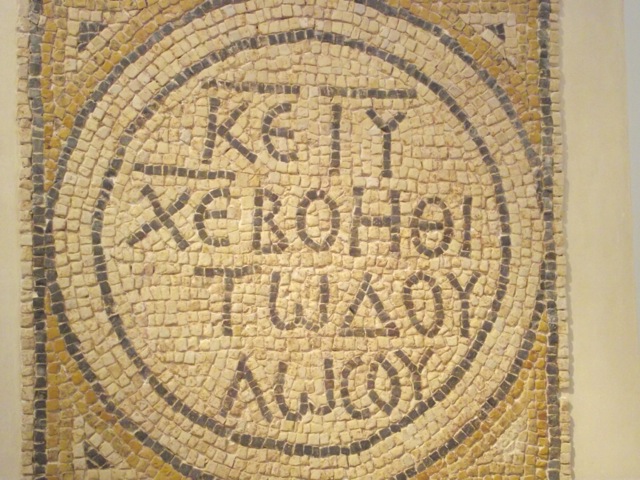
This inscription found at Shiloh is a short cry to Christ for deliverance. It reads “Lord Jesus Christ resolve the cries of your servant.” This writing contains many characteristics of the ancient Attic Greek dialect rather than the expected Koine dialect of that region in the fourth century. Besides the mysteries of the misplaced Greek dialect and the presence of the Church at Shiloh, the obvious question is why did the church take the time to make such an inscription.
These short sayings are a snapshot of the Early Church. Their beliefs and practices were embodied in such short writings. The most important part of the inscription is the vocative at the beginning: Lord Jesus Christ. Two other inscriptions found at Shiloh begin with the exact same vocative. It leaves no doubt as to the theology of the group who wrote this. This was written by followers of Jesus Christ as the Messiah.
The location of this inscription is interesting. Shiloh historically is a Jewish site. It is where the Ark of the Covenant was housed in the Tabernacle for 369 years. This is where Eli reigned as High Priest and raised the prophet Samuel. Since the city’s destruction in approximately 1050 BCE it was rarely inhabited until the fourth century when the Early Church posed a presence there. The only plausible conclusion that can be drawn from the Early Church’s presence there is they were very closely connected to their Jewish roots.
What does this writing tell us about the Early Church? Why is this inscription at Shiloh? Shiloh is theologically and prophetically significant. This is the city where the Ark of the Covenant with the Shekinah glory of God was housed. The Early Church well understood their connection to the Shekinah Glory of God. When Jesus died on the cross the veil of the Temple was torn in two from top to bottom. The Shekinah glory of God was not there. Jesus told His disciples that He would send them the Holy Spirit to them and to wait for it. Fifty days after Jesus death He sent the Holy Spirit and it fell on the Early Church in Solomon’s porch in the Temple complex. Shiloh was known for its connection to the Ark of the Covenant and the Shekinah Glory.
Shiloh is also known in connection to prophecy. Genesis 49:10 says, “The scepter shall not depart from Judah, nor a lawgiver from between his feet until Shiloh come and unto him shall the gathering of the people be.” Did the Early Church literally look to Shiloh as a place of prophetic significance?
What is the significance of the inscription in light of the context it was placed? The Early Church anxiously waited for the Messiah to come back and establish His kingdom on earth and thus relieve their oppression. The Early Church of the fourth century faced much opposition. They were considered a threat by the mighty Roman Empire. Their ethics and morals contradicted the philosophy of the Roman Empire. The Early Church was considered occult by the religious Jews led by the Pharisees and Sadducees. They even faced internal opposition from groups that desired to derail the pure form of the church. The Council of Nicaea in 325 brought many problems to the Church.
The hope of the Early Church was the return of the Messiah. They placed their complete trust and loyalty in Jesus the Messiah. They did everything they could to pave the way for the return of the Messiah. This was their primary focus. It was their vision!
© Dr. Steven L Smith 2015
Rarely is writing found in a tile mosaic. When writing is found it is usually not significant. Most inscriptions in mosaics are tributes to the person who paid to have the mosaic made. When writing is found that is not a tribute it is normally very significant. It gives us a snapshot of the beliefs and practices of the group that made it.
Three tile mosaic floors of an Early Church were found in Shiloh. The three room church building was accidently discovered in 2006 when workers were digging a trench to drain the rainwater so it would not damage the ancient basilica there. Archaeologists date this church back to the fourth century.
This inscription found at Shiloh is a short cry to Christ for deliverance. It reads “Lord Jesus Christ resolve the cries of your servant.” This writing contains many characteristics of the ancient Attic Greek dialect rather than the expected Koine dialect of that region in the fourth century. Besides the mysteries of the misplaced Greek dialect and the presence of the Church at Shiloh, the obvious question is why did the church take the time to make such an inscription.
These short sayings are a snapshot of the Early Church. Their beliefs and practices were embodied in such short writings. The most important part of the inscription is the vocative at the beginning: Lord Jesus Christ. Two other inscriptions found at Shiloh begin with the exact same vocative. It leaves no doubt as to the theology of the group who wrote this. This was written by followers of Jesus Christ as the Messiah.
The location of this inscription is interesting. Shiloh historically is a Jewish site. It is where the Ark of the Covenant was housed in the Tabernacle for 369 years. This is where Eli reigned as High Priest and raised the prophet Samuel. Since the city’s destruction in approximately 1050 BCE it was rarely inhabited until the fourth century when the Early Church posed a presence there. The only plausible conclusion that can be drawn from the Early Church’s presence there is they were very closely connected to their Jewish roots.
What does this writing tell us about the Early Church? Why is this inscription at Shiloh? Shiloh is theologically and prophetically significant. This is the city where the Ark of the Covenant with the Shekinah glory of God was housed. The Early Church well understood their connection to the Shekinah Glory of God. When Jesus died on the cross the veil of the Temple was torn in two from top to bottom. The Shekinah glory of God was not there. Jesus told His disciples that He would send them the Holy Spirit to them and to wait for it. Fifty days after Jesus death He sent the Holy Spirit and it fell on the Early Church in Solomon’s porch in the Temple complex. Shiloh was known for its connection to the Ark of the Covenant and the Shekinah Glory.
Shiloh is also known in connection to prophecy. Genesis 49:10 says, “The scepter shall not depart from Judah, nor a lawgiver from between his feet until Shiloh come and unto him shall the gathering of the people be.” Did the Early Church literally look to Shiloh as a place of prophetic significance?
What is the significance of the inscription in light of the context it was placed? The Early Church anxiously waited for the Messiah to come back and establish His kingdom on earth and thus relieve their oppression. The Early Church of the fourth century faced much opposition. They were considered a threat by the mighty Roman Empire. Their ethics and morals contradicted the philosophy of the Roman Empire. The Early Church was considered occult by the religious Jews led by the Pharisees and Sadducees. They even faced internal opposition from groups that desired to derail the pure form of the church. The Council of Nicaea in 325 brought many problems to the Church.
The hope of the Early Church was the return of the Messiah. They placed their complete trust and loyalty in Jesus the Messiah. They did everything they could to pave the way for the return of the Messiah. This was their primary focus. It was their vision!
© Dr. Steven L Smith 2015